Building the Infrastructure AI Actually Needs

Why Mozilla Ventures backed Union.ai’s bet that AI infrastructure should be open.
Deploying AI in the enterprise has led to impressive demos but when real traffic moves through enterprise systems, things start to behave differently. A workflow that looked stable in staging slows under load, or a dependency behaves differently than expected.
Today, the hard part is no longer just finding the right model but keeping the system around it from breaking.
AI in production means coordinating training, evaluation, deployment, monitoring, retries, logging, and versioning across probabilistic components. It means workflows that branch at runtime and failures that cannot be replayed from the beginning without incurring costs. That gap between experiment and production is where reliability is tested.
Union.ai is building infrastructure for that gap. Mozilla Ventures backed Union.ai because a durable, open development infrastructure is foundational to Trustworthy AI.
The production reality
Many orchestration tools were originally designed for predictable workflows. The same input produces the same output. AI systems behave differently.
They generate outputs that are non-deterministic. Agentic systems branch based on intermediate decisions. They interact with external systems in ways that are hard to predict.
Teams are discovering that experimentation is no longer the bottleneck. Deployment and operationalization is. A few examples include a model passing validation but failing in deployment, or a workflow collapsing when a library version changes. Too often, debugging requires stitching together evidence across environments. At some point, the constraint is not the model itself but the layer coordinating everything around it.
Union.ai builds resilience into AI workflows and agents by making failures recoverable, and inspectable under real conditions.
Why this matters
Reliability at this layer affects more than developer experience. Systems that cannot be automatically recovered, versioned, or monitored are difficult to audit.
Trustworthy AI is as much an operational challenge as a policy one. Operational trust depends not only on tooling, but on whether that tooling remains open to inspection.
Open source as ecosystem strength
Union.ai was founded in 2020 as the enterprise AI orchestration platform behind Flyte. Flyte has surpassed 80 million downloads and powers AI orchestration for 3,500+ companies. Union.ai’s open-source portfolio also includes Pandera, a data validation framework with more than 100 million downloads.
Mozilla’s open-source AI strategy emphasizes agency and choice. By building an open source orchestration layer, teams have visibility into how systems behave and how decisions are executed. That visibility makes accountability practical and increases resilience.
A team working at the right layer
Ketan Umare, Union.ai’s co-founder and CEO, first encountered the limitations of traditional orchestration tooling while leading machine-learning engineering work at Lyft. There, Flyte, the open-source AI orchestrator at the heart of Union.ai, was developed to help disparate teams coordinate complex ML workloads that conventional tools weren’t designed to handle.
That conviction grew out of hard production lessons, where orchestration determined whether experiments ever became real systems.
“I founded Union.ai with a singular mission: to make orchestration of machine learning easy and repeatable, so teams of any size can turn experimentation into reliable production systems,” said Ketan. “Recognizing the gap between iterative ML work and production-grade infrastructure, we built Flyte to bring engineering rigor to AI workflows.”
Over years of real-world use across industry, from ride-hailing to media and financial services, Flyte’s open-source community grew as engineers adopted it for production workflows. That adoption, paired with persistent infrastructure friction in AI pipelines, inspired Union.ai to formalize and extend the tooling into a commercial platform that retains open-source DNA while helping teams move from experimentation to durable, production-grade systems.
Investing in Union.ai
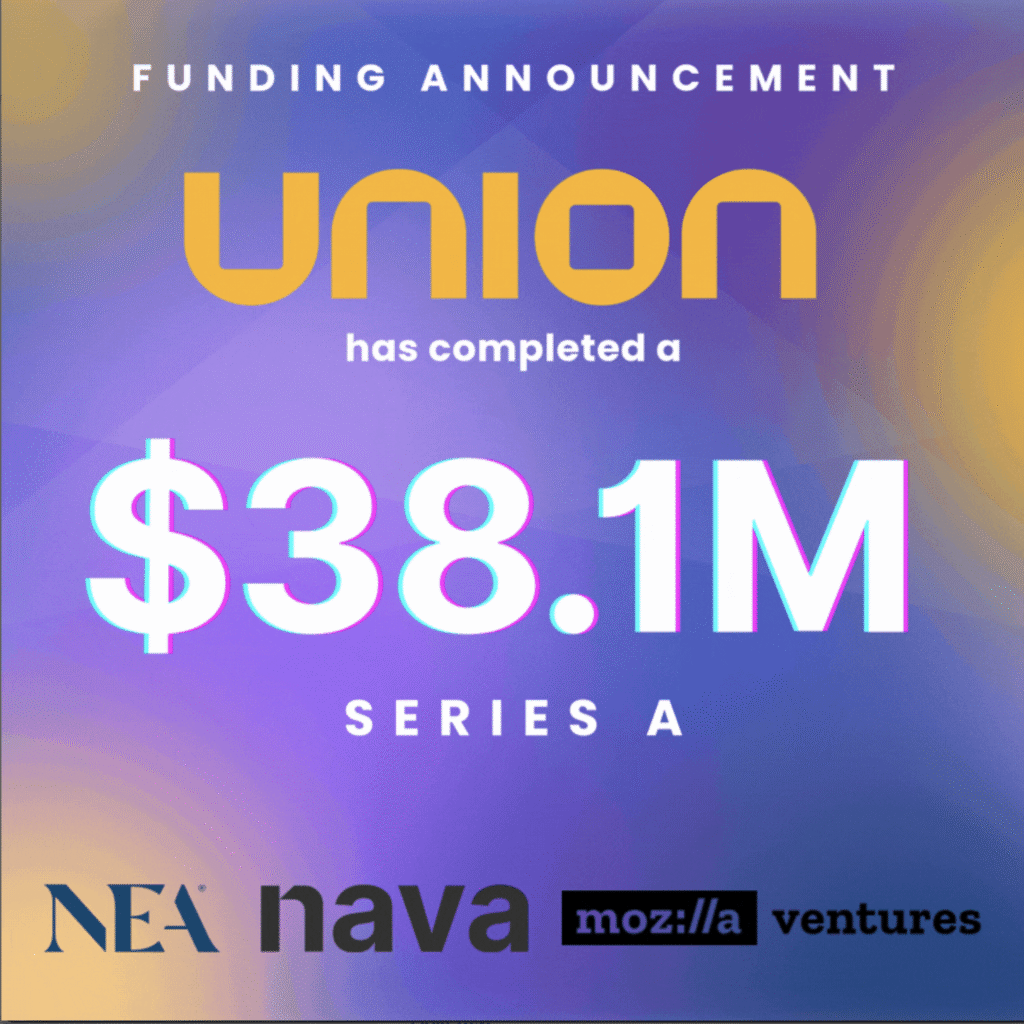
For Mozilla Ventures, we believe that building Trustworthy AI needs to be built across the development and deployment stack. That’s why we were excited to partner with Ketan and the Union.ai team and invested in their recent Series A led by NEA.
The funding supports the commercial launch of Union.ai 2.0 and continued investment in supporting open-source AI.